

Hey there, Last Night In Basketballers — I am, as I do every year, re-appropriating the Three Things I Noticed on League Pass format to preview the upcoming season. Instead of three things I noticed, it’ll be something more along the lines of three things I’m looking forward to, interested in, or want to see. Some of them might be narrative-based, some might be stats, and some might include video. But they'll all be focused on the 2026-27 campaign.
The schedule for those posts will be as follows (podcasts previewing each division with Mo Dakhil are in parentheses):
- Atlantic Division (BOS, BKN, NYK, PHI, TOR) (Podcast)
- Central Division (CHI, CLE, DET, IND, MIL) (Podcast)
- Southeast Division (ATL, CHA, MIA, ORL, WAS) (Podcast)
- Pacific Division (GSW, LAC, LAL, PHX, SAC) (Podcast)
- Northwest Division (DEN, MIN, OKC, POR, UTA) (Podcast)
- Southwest Division (DAL, HOU, MEM, NOP, SAS) (Podcast)
So without further ado, let's get to the Utah Jazz, who are actually trying to be a real basketball team this year.
Keyonte George, encore?
George signed a five-year, $157.5 million contract extension a few weeks ago. Mo and I discussed the contract in detail on the podcast, but my basic take was this: if George plays anything like he did last season, it's a steal for the Jazz; but if he plays anything like he did in his first two seasons, it's a disaster for the Jazz.
Where you fall on whether George's massive improvement last year was for real or not likely dictates how you feel about the deal. Predictably, I fall somewhere in the middle.
Last year was just so much better than the first two. Everyone talks about the three-point shooting improvement (from 34% to 37% on similar volume), which was definitely important, but the two-point shooting and especially the interior finishing getting better was way more so.
George shot 39.1% from the field in each of his first two seasons because he couldn't make his twos at a high enough rate, shooting 45.9% and 44.9%, respectively, in Years 1 and 2. Last year, he bumped that number all the way up to 51.5% thanks improved finishing in the immediate area around the basket (75.3% within three feet of the rim), as well as from floater range (50.2% from 3-10 feet) and the deep mid-range (42.4% from 16-23 feet).
He also showed continued improvement at getting to the line (his free-throw rate has jumped from 0.274 to 0.310 to 0.429 in his three NBA seasons), thanks in large part to a significant shift in his shot distribution.
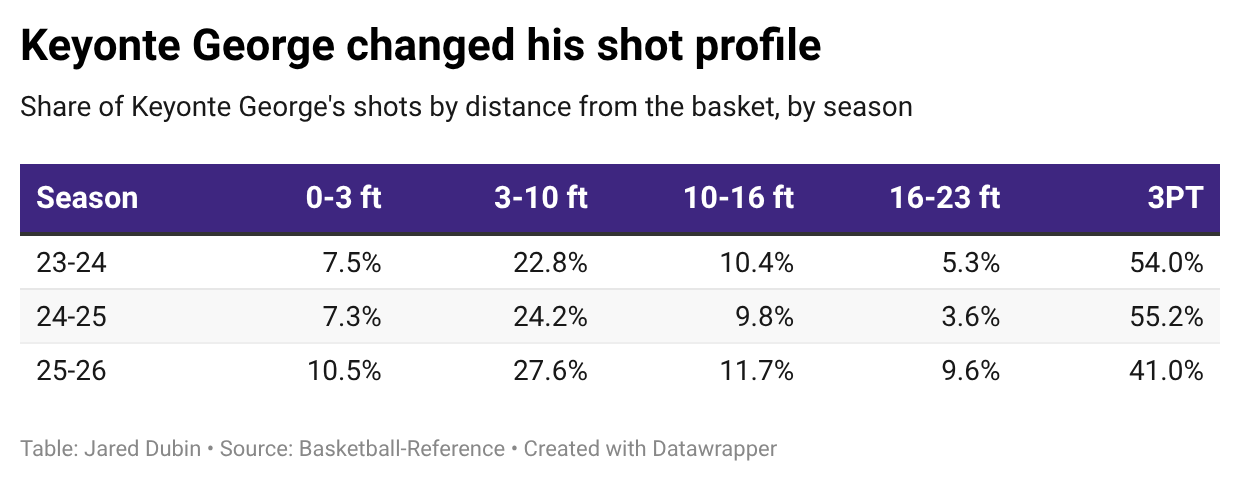
Whereas around 30% of his shots originated within 10 feet of the basket through his first two seasons, that share jumped up to around 38% last year. And whereas 54-55% of his shots were threes in his first two seasons, that number dipped all the way to 41% last season. Basically, he got more efficient by taking and making more shots closer to the rim, and making more of the ones he took from farther away.
He also continued to take slight steps forward as a passer, as evidenced by his totaling more assists despite the fact that his teammates underperformed their expected effective field-goal percentage on his passes, per GeniusIQ tracking.
You might notice that every single improvement I'm noting came on the offensive side of the floor. That's on purpose, because George continued to be one of the most damaging defenders in the league last year (he literally finished dead last among 602 players in Defensive EPM, and other all-in-one stats like LAKER and LEBRON and DARKO saw him as an extreme negative on that end as well), and that's something that has to change if he wants to be a truly positive force on the floor.
I'm not sure that I think last year is just the new baseline and he can only get better from here. Improvement isn't linear, as we know, and I do think it's at least somewhat notable that George basically didn't play at all after January (seven games from February through April), so we didn't get a chance to see if he could sustain his new level through an entire season. That does matter to me.
Basically, I'm optimistic that he's better than he was in his first two years, but I'm not 100% certain that he's as good as he was last year. If he settles somewhere in the middle of those two poles, I'm not sure how I feel about the contract. We'll have to find out.