

Hey there, Last Night In Basketballers — I am, as I do every year, re-appropriating the Three Things I Noticed on League Pass format to preview the upcoming season. Instead of three things I noticed, it’ll be something more along the lines of three things I’m looking forward to, interested in, or want to see. Some of them might be narrative-based, some might be stats, and some might include video. But they'll all be focused on the 2026-27 campaign.
The schedule for those posts will be as follows (podcasts previewing each division with Mo Dakhil are in parentheses):
- Atlantic Division (BOS, BKN, NYK, PHI, TOR) (Podcast)
- Central Division (CHI, CLE, DET, IND, MIL) (Podcast)
- Southeast Division (ATL, CHA, MIA, ORL, WAS) (Podcast)
- Pacific Division (GSW, LAC, LAL, PHX, SAC) (Podcast)
- Northwest Division (DEN, MIN, OKC, POR, UTA) (Podcast)
- Southwest Division (DAL, HOU, MEM, NOP, SAS) (Podcast)
So without further ado, let's get to the Charlotte Hornets, who made some dramatic changes to their team this offseason.
The LaMelo trade, a swerve
Here's an excerpt of what I wrote about the trade:
This is a staggering vote of no-confidence in both Ball and the way the Hornets played over the second half of the season. Charlotte went 30-12 over its final 42 games, with the league's second-best offense, sixth-best defense, and second-best net rating behind only the Spurs. And it cut bait on arguably the best and most important player driving that run, for a return that could be scarce in the worst-case scenario.
It's entirely possible that the Hornets simply decided that Ball would never be more valuable than this, coming off of arguably his best season at age-24; they know more about his body than anybody else and might just think that he won't be able to stay healthy again this year or more generally over the long term. They couldn't have gotten anywhere near this type of package had they tried to trade him at this time last year, for example, when he was coming off yet another injury-riddled season. Now, they were able to generate a bunch of value for him.
The Hornets could also have decided that they just played over their heads for half a season and were unlikely to replicate that success, and that they didn't want to go further in for a team that was likely to top out in the middle of the conference, instead electing to reset the clock and try to build around Knueppel, Miller, Reid (who is still only 26 and is under team control for at least the next three years before he has a player option for the 2029-30 season), a re-signed Coby White, the recently-drafted Hannes Steinbach and Christian Anderson, and whatever they can get with these newly-acquired draft assets, whether in a trade or by using them outright...
On the floor, things are obviously going to be dramatically different. Ball is gone, replaced by a player in [Coby] White who is almost his diametric opposite. (White's usage rate has eclipsed his assist rate in each of his NBA seasons; Ball's never has.) I have no idea how the Hornets are going to run anything remotely resembling the offense that blitzed the league over the second half of the season. Charles Lee is a really good coach and could figure something else out, but he is undoubtedly going to have to figure something else out, and that's a pretty significant risk.
It's pretty rare to see a team exceed expectations like the Hornets did and then voluntarily take a step backward rather than try to hit the fast-forward button. It's a really interesting team-building move.
But the goal isn't to be a fun, feisty play-in team; it's to be a real contender. The Hornets obviously think that having the future assets gives them a better chance to do that than did having Ball and continuing on their same path. Whether that's true, we'll obviously find out, but I'm fascinated by the bet either way.
Knueppel and Miller, on the ball
Here's another excerpt:
I'm fascinated to see what self-creation from Knueppel and Miller looks like, because neither of them did all that much of it this past year. Just 7.7% of Knueppel's threes this season were unassisted, and the same was true of only 40.9% of his twos. Those figures were 18.6% and 52.4%, respectively, for Miller. They were both mostly play-finishers, not creators, with Ball doing the significant majority of the work to get them looks. White is not going to do the same thing at anything approaching the same level.
The play type numbers are interesting. Knueppel had 160 isolations, per GeniusIQ tracking, and he averaged 1.099 points per direct play. (One that ends with a shot, turnover, or foul drawn by the ball-handler or a teammate one pass away.) That checked in 19th out of 157 players with 100 isolations or more. Pretty damn good! The volume was quite low, though, at 155th in isolations per 100 possessions among that group. Pretty damn small sample!
Miller was 84th in isolations per 100 possessions among the same group (226 total), and scored 1.062 points per direct play. That ranked 34th out of the group of 157 players. Again, pretty good efficiency, but middling at best volume. I wonder how it holds up for both of them with more opportunities.
Meanwhile, Knueppel ran 11.8 pick and rolls per 100 possessions, which is actually more than I would have thought. Still, that ranked 96th out of the 102 players who ran 500 or more pick and rolls. His efficiency, though, was quite good: 1.059 points per direct play, which ranked 18th out of that group of players. Miller ran 23.4 pick and rolls per 100 possessions, 75th out of the group, and checked in with 1.053 points per direct play, which ranked 21st.
Both players have handle, can shoot off the dribble, and are pretty decent passers. I do wonder how it all works when they run these actions as the primary ball-handler rather than on the second side and against a rotating defense; but given the efficiency numbers from both players, perhaps the Hornets having faith that they can do more with the ball in their hands, more often, is something that I should be buying more than I initially thought.
Shooters, shooting
The Hornets have assembled a pretty sizable collection of shooters: Knueppel, Miller, White, Reid, Grayson Allen, and Royce O'Neale.
Five of those six players have attempted at least 7.8 threes per 36 minutes in their career (three of them have attempted at least 9 per 36), and the other one is at 5.8 per 36. Five of them have made at least 37% of their career threes (two of them have made at least 40%), and the other one is at 36.9%.
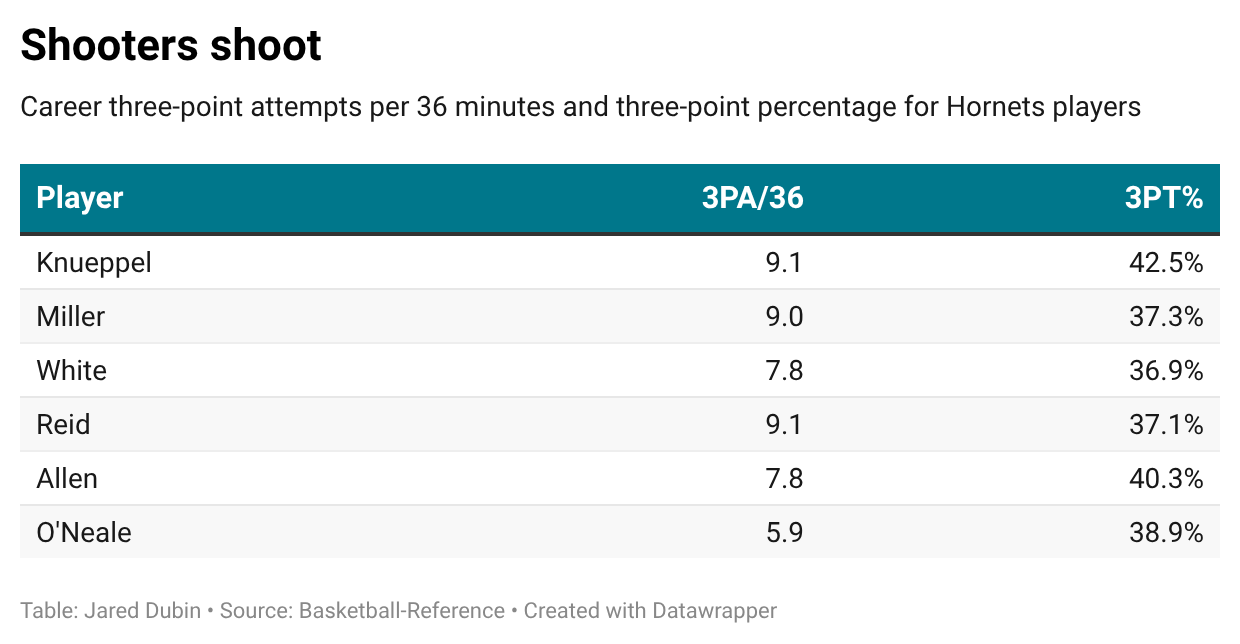
They may not have much in the way of playmaking for others on their roster (I hate to keep harping on this, but I think it's that significant an issue), but they do have a lot of guys who are going to let it fly. Because they don't have a true creator, I wouldn't be surprised if those three-point percentages came down, but launching a ton of threes and making them at a slightly above league-average rate without necessarily having an elite creator for others is actually probably a decent formula for a pretty good offense. That's basically the Celtics' formula for example.
The difference, obviously, is that the Celtics have Jayson Tatum and, until this year, Jaylen Brown. The Hornets, even if you think highly of Knueppel and Miller (and I do), do not have anyone to draw the same type of defensive attention that those guys do. I expect the three-point rate for the Hornets to be sky-high, but I'll definitely be watching to see how many guys don't shoot quite as well as their career marks, because they aren't being gifted quite as easy of looks as they've gotten used to.


