

First off, apologies for the lack of posts earlier this week. I had to work out a new pricing plan with Ghost because of an influx of new subscribers. (Ghost charges you a fee based on the number of subscribers you have, and I moved into a new tier based on that number. You can't publish until you agree to the new fee, and it took me a few days to work out the finances.) Having the new subscribers is obviously great, but that's something that had to be figured out over the last few days. It's now figured out, so we'll be back to a more regular posting schedule going forward.
Now that that has been handled, with the exception of Aggression+ and Variance+, all of the stats we keep track of here at Last Night In Basketball have been updated for the 2026-27 season. That means that WAADE (Wins Above Age-Derived Expectation), Adjusted Efficiency, Moreyball Rate, and the Possession Battle will now update daily throughout the rest of the season. I'll work on getting the Aggression and Variance data going as soon as possible as well.
With that in mind, let's take a look at a few of the early-season trends we're seeing from those stats and a few more.
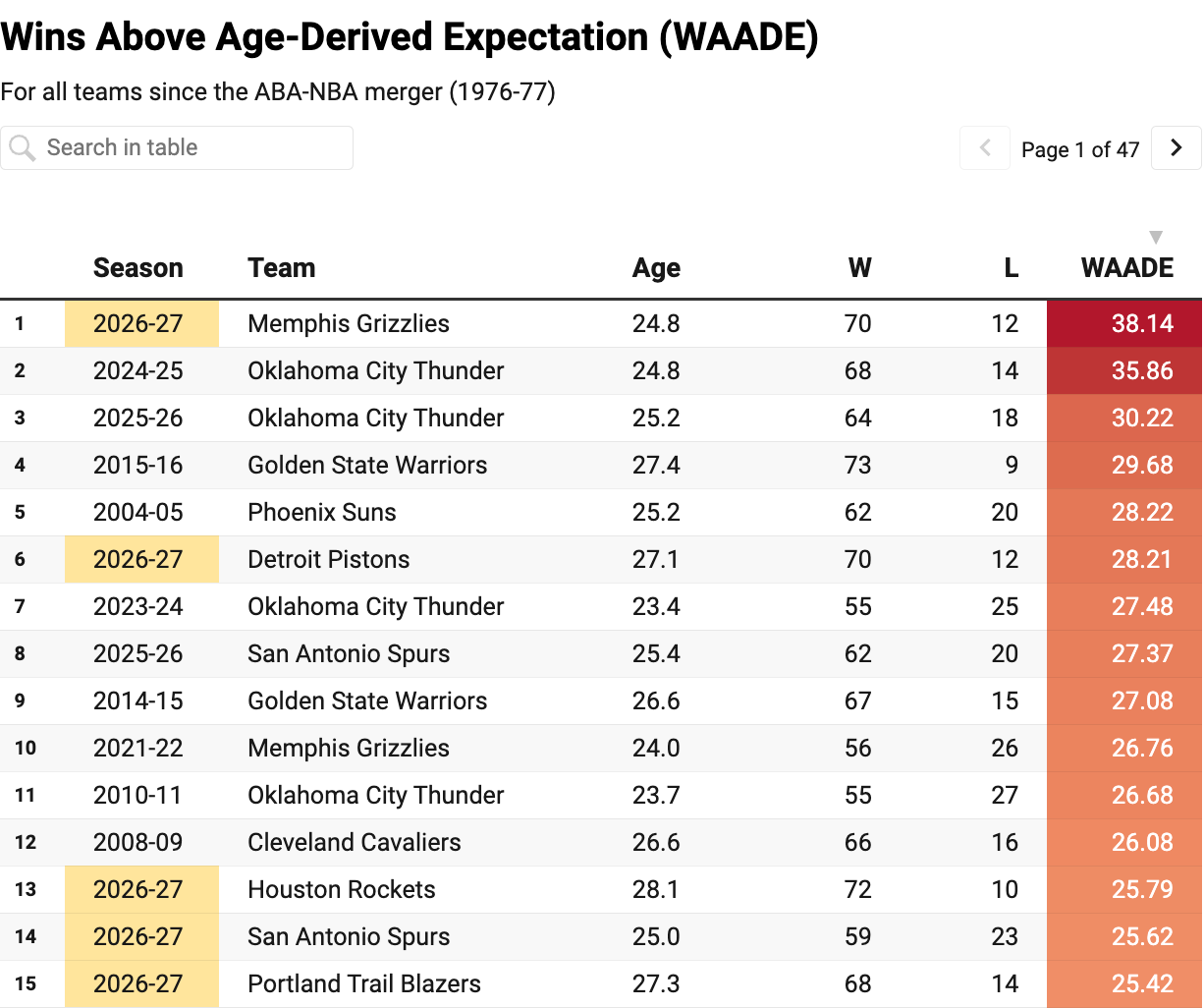
- This early in the season, you're going to have some extreme results, and so here we have five of the top 15 teams in WAADE, with the Grizzlies on track to smash the 2025 Thunder's all-time record by almost three full wins. Is any of this stuff going to hold up? Almost certainly not. These teams, with the exception of the Spurs, are all on track for 68 wins or more. That's just not going to happen — especially in a league where more teams are trying on a nightly basis. The Spurs, though, could stay in this game. They could conceivably win 50 or so games and crack the top 10 or 15 all time in WAADE. I would almost be surprised if they didn't, actually. The Pistons could, I suppose, win 60 or so again, but dropping off into that range would knock them out of the top 15 here due to their minutes-weighted age being around average. The Thunder are 76ers are also currently on track to join the top 30 in WAADE, but OKC's injury issues and Philly's minutes-weighted age will probably keep them out of the true upper echelon above.
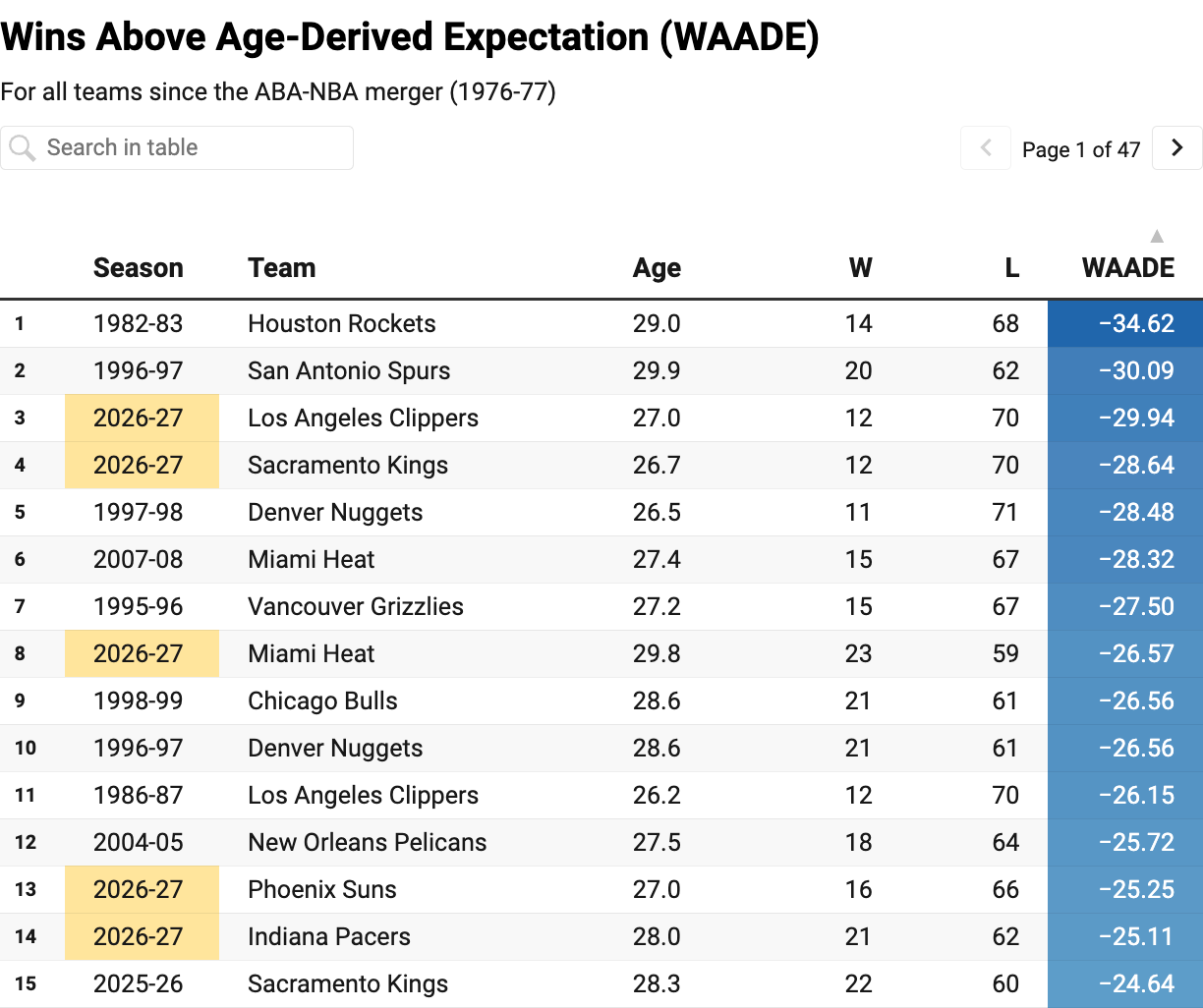
- On the opposite end of the spectrum, we also have five teams in the bottom 15 in WAADE. Again, it's early, so the results are extreme. But teams like the Kings and Clippers sure seem like they could end up down in this range. They could easily win only 22 or 23 games or something along those lines. The Heat being this far down is obviously pretty nuts, but it's worth noting that their minutes-weighted age of 29.8 years old is over the cliff where wins tend to fall off. Generally, older teams are better than younger ones, but only up to a certain point. Once you get past 29 or so, things start to dip again. The Nets, Bulls, and Bucks are all on pace for only 12 wins and thus in the bottom 30 of WAADE, but their minutes-weighted ages are all between 25.3 and 25.5, so it'll be tough to climb toward the very bottom of the charts unless they win in the single digits or something.
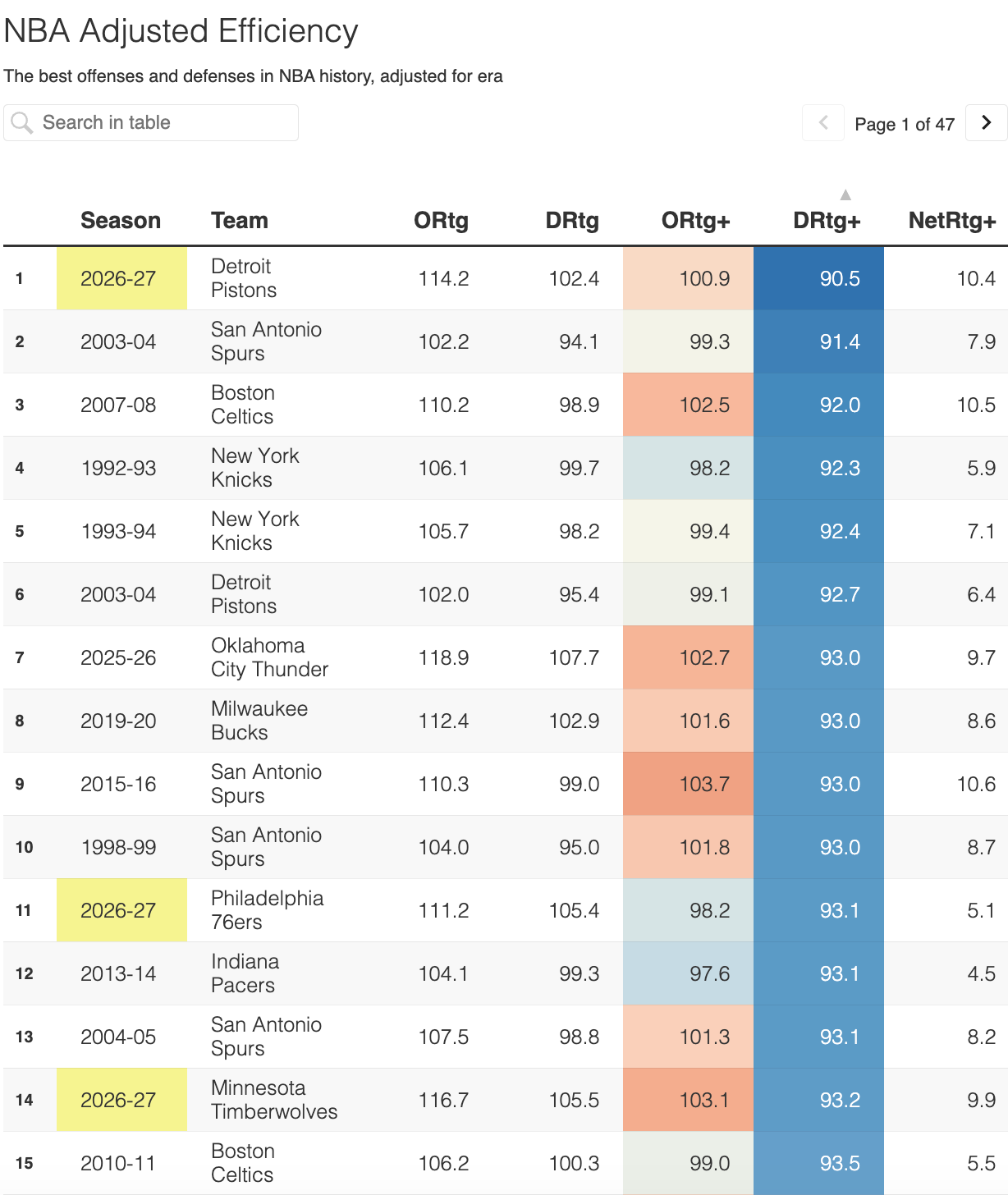
- The Pistons are currently on track for the best defense since the merger, by nearly a full percentage point. Their defensive rating of 102.4 in a league where the average is 113.1 makes them 9.5% better than average. That's probably not going to stick, but it's worth noting that last year's team had a DRtg+ of of 94.7, which is 42nd all time. Seeing the Sixers on the list above is maybe the most surprising development of the season, given the concerns I and many others had about their defense coming into the year. They are getting by mostly on field-goal percentage defense. Opponents are shooting only 31.8% from three, which will rebound, but Philly is also doing a great job of limiting three-point volume, which should help cancel that regression out a bit. The Wolves ending up here is less surprising given how good they've been defensively during the Rudy Gobert era, but they did drop off to eighth in the league defensively last season after finishing first and sixth the two years before, so this is a nice early rebound.
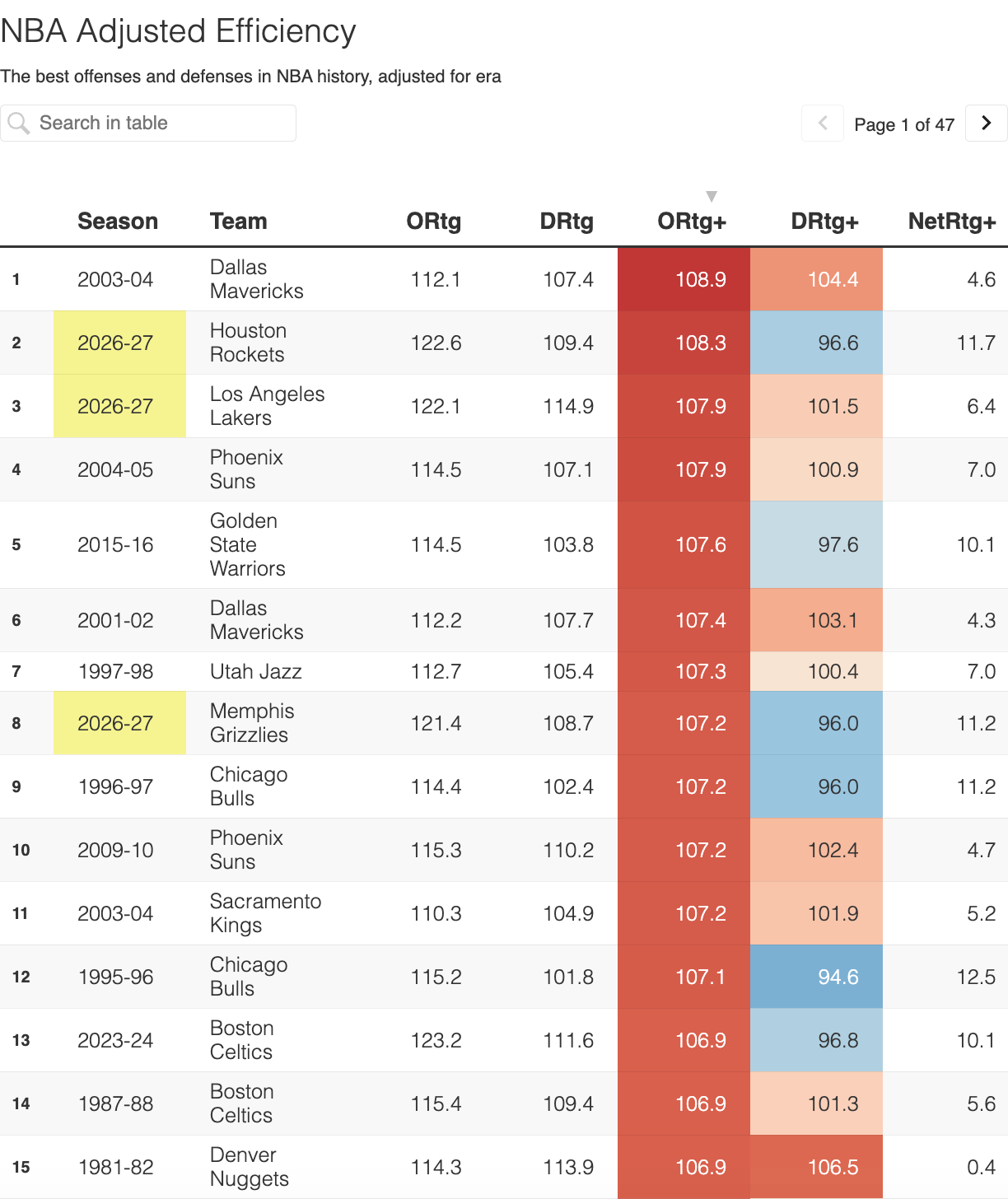
- I pretty much expect the Lakers to challenge for this range of the list given what Luka Doncic is doing this year. Maybe they won't finish in the top three all time, but I think an ORtg+ of 106 or better is firmly on the table for them. I'm less convinced for Houston, but the Rockets are shooting and rebounding the crap out of the ball and parading themselves to the free-throw line, so maybe I'm just wrong on that one. They don't take very many threes, though, and once they stop hitting them at a 39%-ish rate, they'll probably drop back toward the pack. The Grizzlies being up here is insane, but that's just what you get when you have an MVP-caliber player like Ty Jerome. For what it's worth, on the opposite end of the spectrum, the Hornets are currently on track for the second-worst offense of all time. It's early and Kon Knueppel has been out, but things have been ugly down there so far in the post-LaMelo Ball era.
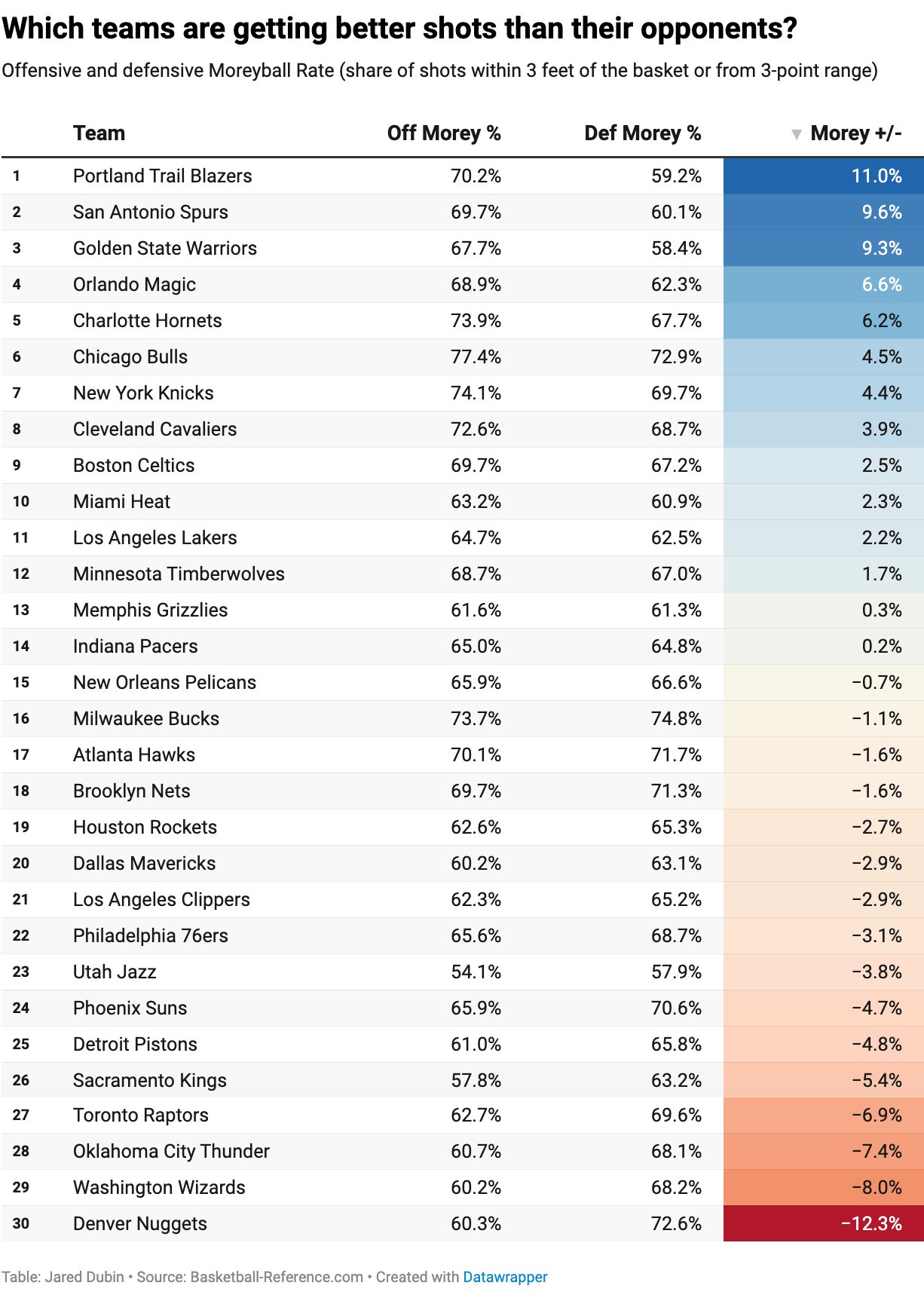
- The headline here is the Nuggets, who have a ridiculous -12.3% Morey plus-minus. A team with Nikola Jokic is generally going to get great shots in most seasons, but that's just not happening so far. Denver is 26th in Moreyball Rate and 28th in Opponent's Moreyball Rate. The Nuggets are only 18th in the share of shots coming at the rim, which is actually up from last year, but they're down from 17th to 24th in the share of their shots coming from three. And on defense, they're giving up the fourth-most shots at the rim. That's not really tenable. The Blazers checking in with the best plus-minus in the league is also obviously notable, especially given that they have a new coach. Kudos to Micah Nori for getting a team that pretty much everybody thought would be defense-challenged, to defend well enough to force opponents into the in-between areas of the floor rather than from the rim or from deep.
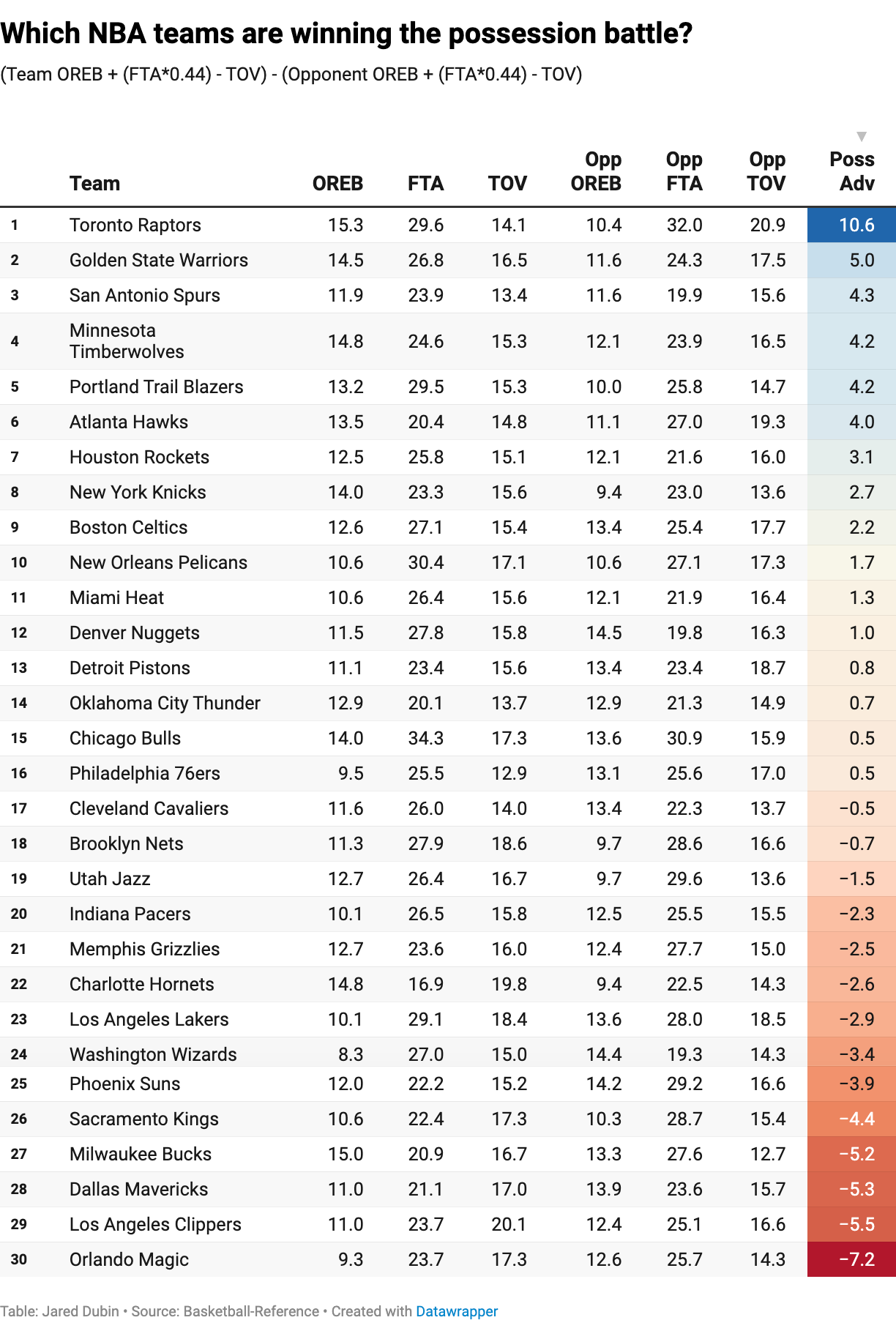
- The Raptors are dominating the possession battle so thoroughly that they are winning it by more than twice as much as the next-closest team in the NBA. That is completely insane. Their ability to force turnovers on a nightly basis is just nuts. Between that and the offensive rebounding advantage they have so far, it's easy to see why they're so far ahead. The Magic being last on this list represents a significant sea change from where they have been over the last few years, when they've typically resided near the top. They're not getting offensive rebounds and they're turning the ball over like crazy.
- A few other early-season trends I've noticed:
- Scoring is down from 115.8 points per 100 possessions to just 113.1 per 100. Offense does tend to pick up over the course of the season, but that's a pretty significant gap to make up.
- Some of that is because the leaguewide turnover rate is up from 12.7% to 13.9% this year. There are only a few ways a possession can end, and only one of them results in the offense not getting a shot at all, and it's a turnover. Fewer shots going up means offense is going to lag behind.
- Offensive rebound rate is up again, all the way to 27.3% from 26.0% a year ago. That's in keeping with teams valuing the possession battle more, which I wrote about a couple years ago. The same is true of teams forcing more turnovers, I suppose.
- Free-throw rate is also up this year, but fouls tend to be called more often early in the season as the refs harp on the so-called points of education. Things will get looser as the season goes along. They always do.
- Flopping technicals are definitely up early in the year. I like it.
- Teams are switching less often. The leaguewide switch rate is down about 5% year over year and is at its lowest point since 2020 or 2021. That's especially true on guard-to-guard screens, where the switch rate is down even further. Teams are trying not to give up those advantages onto the smaller guard, and they're also trying not to react as much to ghost screens that aren't really screens.
- We're seeing more of that action where teams throw the ball to an uncovered non-shooter and have him immediately pivot into a dribble hand-off with a shooter. It works a lot because of the way teams are zoning up more often, and how you can get one defender guarding two offensive players at once.


