

Last Night, In Basketball is an independent publication that provides in-depth analysis of what actually happens on the court — covering all 30 teams, throughout the entire season and offseason.
The website and newsletter also depend on reader support.
Purchasing a paid subscription gets you access to features like Three Things I Noticed on League Pass, weekly deep dives into topics of interest, databases for several in-house statistics, and more, while also helping cover costs for things like travel and event coverage, as well as software that provides support for Film Findings videos.
Good morning and happy holidays. I'll take your questions.
From Chris: Is there a second great team? Can there be a second great team?
Let's start by stipulating that no team is as great as the Thunder. I know they've actually lost a few games recently, but I think we can acknowledge that the 26-4 team that is shattering its own record for point differential (set just last year) is in a class of its own.
But just because no team is that great doesn't mean that there aren't other great teams. I think the Nuggets and maybe even the Rockets are great teams.
Basketball-Reference has a stat called Simple Rating System (SRS), which adjusts point differential for strength of opponent. Oklahoma City has a preposterous 13.86 SRS, as of Tuesday afternoon. That's the best mark in the history of the database by over a full point.
But the Rockets are second in the league this year at 8.66 and the Nuggets are third at 7.96. In the history of American professional basketball, only 56 teams have had an SRS of 7.5 or better. That's going all the way back to the 1940s. And the Rockets and Nuggets are on that list, sitting at 24th and 40th, respectively. (Expanding the definition of great to a 6.5 SRS or better gets the Knicks and their 6.94 mark in there, but the full list then expands to 108 teams, and that feels like a bit too many. The Knicks feel like they're more "really good" than "great.")
Here at LNIB, I use Adjusted Efficiency, and the Nuggets and Rockets again each rank inside the top 45 teams since the ABA-NBA merger back in 1976, based on how far above or below average they are on each side of the ball. (Denver specifically has the second-best offense in the history of the database that includes 1,380 teams — which plays a significant role in that ranking. Houston's offense isn't all that far behind, checking in 33rd out of the same group of teams.)
There are degrees of greatness, is what I'm saying here, and I think the relative strength of the Thunder throws off our perception of other teams a bit. Teams can be great but not quite as great as one of the greatest (so far) teams we've ever seen.
From Emma: How will the surge in offensive rebounding do in the playoffs? Will the refs start tightening calls around the rim or will it be easier to scheme for during a series? Thinking of Houston vs Golden State last year, especially.
I don't expect offensive rebound rate to drop off all that much in the playoffs. In the last 25 years, the average differential between regular-season and playoff offensive rebound rate is -0.4%. The rate has dropped more than 1 percentage point only six times in those 25 years, and one of those years was in the bubble.

Another reason I don't expect it to drop off much is that a lot of the best offensive-rebounding teams look like they're going to make the playoffs.
The top five teams in offensive rebounding are the Rockets, Pistons, Blazers, Knicks, and Celtics. Four of those five are playoff locks, and the Blazers could at least make the play-in, which gives them a chance to get into the playoffs as well.
Are there great defensive rebounding teams that could mitigate those advantages? Sure. But given the history of how these things have translated, I figure we'll see an offensive rebound rate very similar to the one posted in the regular season.
From Snow Burrow: Can Wemby stay healthy for a full season? Will the Knicks figure out how to win on the road? Why aren't the Magic better? Will Giannis finish the season as a Buck? Do you expect officiating to allow more physical play as the season goes on like they did last year?
The likelihood of Victor Wembanyama staying healthy for a full season is pretty low. Almost nobody does it anymore to begin with, but research from the absolute G.O.A.T. of injuries Jeff Stotts has also shown that 7-footers drafted in the lottery have tended to miss around 23.5% of their team's games. When I did research for a story on Kristaps Porzingis' health that I wrote during his rookie season, I also found that the number of games missed increased as the 7-footer got older. So, we should probably get used to Vic missing a bunch of time in each season, and hopefully just having him healthy when the playoffs roll around.
I saw that you got into a back-and-forth with someone about this on BlueSky but I do think it's worth noting that the Knicks started 1-5 on the road and have won four of their last five away from home heading into Tuesday night's Jalen Brunson- and OG Anunoby-less game against the Timberwolves. They also won a pair of games in Las Vegas, which aren't road games but are at least games away from Madison Square Garden — and against very good teams. The idea that a team as good as the Knicks "can't" win away from home doesn't pass the smell test to me either way, so yes, I expect them to figure out how to win on the road, if they haven't already.
With the Magic, I think it's as simple as injuries and a lack of cohesion due to those injuries. They stumbled early in the season before seemingly getting back on track for a little while, and then stumbling again of late. (I think it's worth noting that their recent losses are to the Spurs, Knicks twice, Nuggets, and Warriors.) They've also had Franz Wagner miss five games, Jalen Suggs miss eight, and Paolo Banchero miss 10. Those guys have rarely played together. When you don't have your team, it's hard to be as good as you're expected to be. Can some teams overcome injuries and do exactly that? Sure. But those are mostly the best teams. The Magic appear to mostly be a pretty good one, and those types of teams aren't necessarily equipped to operate at peak form when not at full strength.
I do expect Giannis to finish the season with the Bucks. It's just so much easier to trade a player like him, with his salary, in the offseason — and it is especially easier to send him to his preferred destination this offseason when the Knicks have some draft picks freed up and won't be constrained by being a few thousand dollars away from the second apron. (That doesn't mean the Knicks will get him, of course, but it doesn't hurt to have them in the mix.)
Research has shown that foul rates tend to decline over the course of a season, which makes sense. Officials are emphasizing the so-called "points of education" to start the year and as teams get used to them, they get called for fouls less often. We've also seen the trend, as you mentioned, of allowing more physicality as the season goes on and especially in the playoffs. Everybody, everywhere has loved this unless and until their favorite team plays against the Thunder, so I do expect this to continue, along with the freak-outs from whichever fan base has the misfortune of going up against Oklahoma City.
From Love the Haters: Will a human 6 foot 2 and or under ever win MVP?
So, it's worth noting that three humans listed at 6-2 or shorter have already won MVPs: Stephen Curry won twice, Allen Iverson won once, and Bob Cousy won once. (I think Steph may have been listed at 6-3 at the time he won, but both NBA.com and Basketball-Reference have him at 6-2 now that teams are required to measure official height.) Obviously, that is not very many times. The MVP has been given out 70 times, so players 6-2 or shorter have won it less than 6% of the time.
But this question did get me thinking about the history of height in MVP voting, so I went back and looked up the height of every MVP since the award starting being handed out back during the 1954-55 season, then calculated the five-year rolling average of MVP height for each of those seasons to see how it has fluctuated over the years.
And we are definitely in an upswing period right now, which is incredibly interesting because it's followed a precipitous downswing that saw the award reach its lowest five-year rolling average height ever after James Harden won in 2017-18.
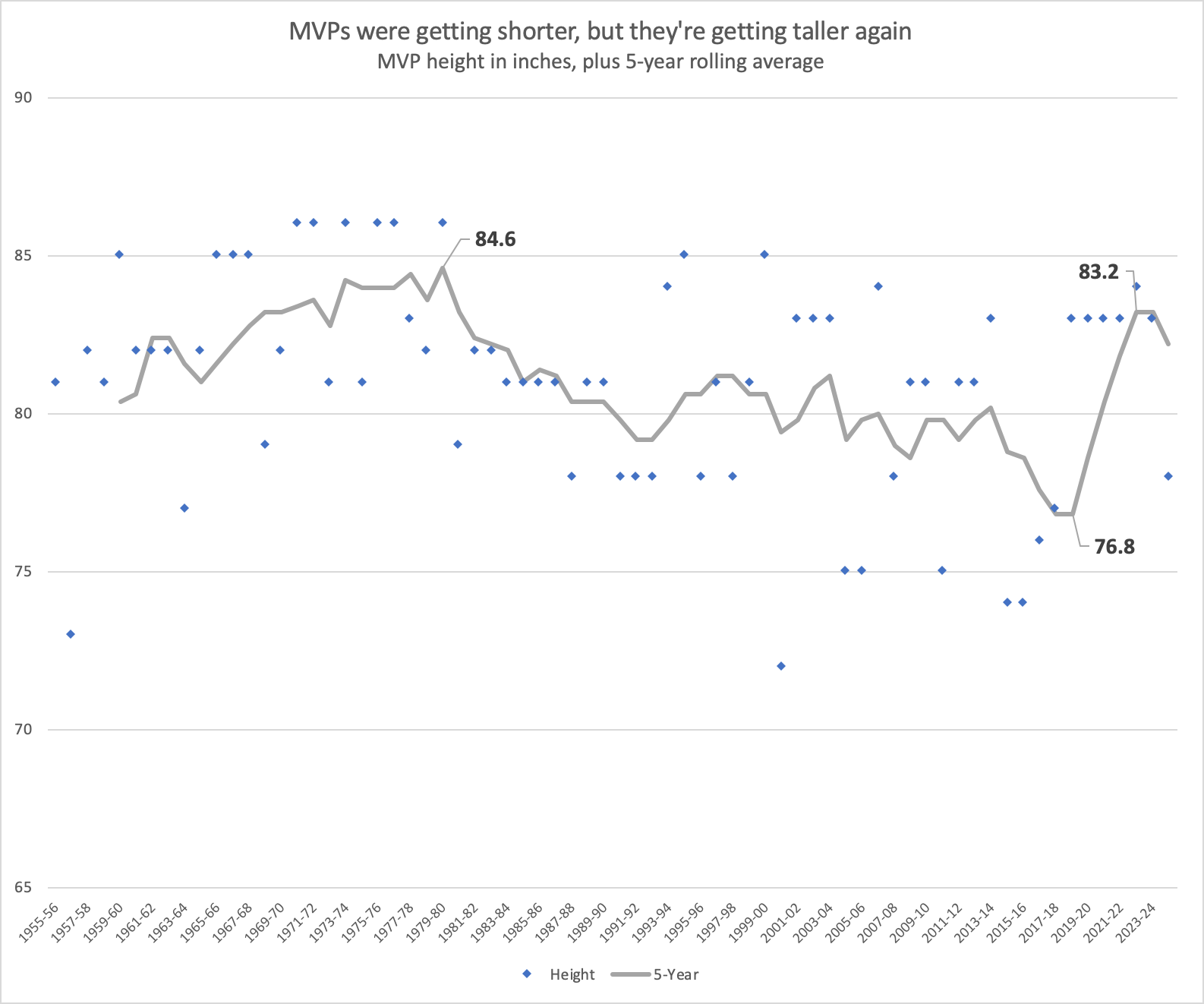
The tallest the MVP has ever been came from 1976 through 1980, when Kareem Abdul-Jabbar won three times, while Bill Walton and Moses Malone each won once. During that five-year span, the average MVP was over 7 feet tall.
During the five-year period leading up to Harden's win in 2018, the MVPs were Kevin Durant, Stephen Curry (aka the third-shortest player to ever win the award) twice, Russell Westbrook, and then finally Harden. At that point, the average MVP was just shy of 6-5.
Starting immediately after that, though, we moved into an era dominated exclusively by huge guys before Shai Gilgeous-Alexander won last year. From 2019 through 2024, the award was won by Giannis Antetokounmpo twice, Nikola Jokic three times, and Joel Embiid once. So the five-year rolling average height during that span was just over 6-11.
Getting back to the original question, history would tell us that it's fairly unlikely — but still possible — that someone 6-2 or shorter will win the award again at some point.
I do think it's worth noting, though, that players 6-2 or shorter aren't as common as they once were. All else equal, teams would prefer bigger players, and nowadays bigger players are becoming just as skilled as smaller ones. The advantage that shorter players used to have was that they could shoot and pass better than their taller counterparts; and that advantage is, if not gone, then shrinking quickly. So it may be possible that those shorter players get phased out over time.
HOWEVER, the ones that don't get phased out, will be so talented as to overcome the height deficit they face compared with other players. And those players — the ultra-talented ones — are the ones that tend to win MVP awards. It seems at least somewhat likely to me that there'll be another player that size who is simply so good as to be undeniable and thus able to claim the trophy.


